4 Advantages of Using Through-Hole PCBs

There are two main ways of mounting electronic components to a printed circuit board: through-hole mounting and surface mounting. Surface mounting is a relatively newer method that doesn’t require the use of wires as components are directly soldered to the circuit board.
In contrast, the through-hole mounting requires the manufacturer of the circuit board to drill hoes during the manufacturing process so that they can place leads into these drilled holes.
Let’s discuss some benefits of PCBs using through-hole mounting.
1. Through-Hole Mounting Results in Stronger Mechanical Bonds
Through-hole mounting has two different types of leads: axial and radial. The axial through-hole components are placed along the axis of symmetry of the electronic components. On the other hand, the radial components are placed in such a way that they protrude parallelly from the same surface on the circuit board.
The through-hole mounting method creates strong mechanical bonds between the circuit board and its components. These stronger bonds are preferred for devices that undergo extreme stress such as collision, high temperature, sudden acceleration, etc.
PCBs that use through-hole mounting are often used in the military and the automotive industry as well in extreme sports equipment.
2. They Have Higher Tolerance for Stress
Through-hole mounting is designed to withstand high amounts of stress. It can meet high power requirements easily and can tolerate significant environmental and mechanical stress. It’s often used in aerospace equipment that is launched into outer space and undergoes extreme temperatures.

3. This Method Increases Component Durability
The through-hole mounting technique is used to mount electronic components such as capacitors, connectors, transformers, and semiconductors to the circuit board. This creates strong physical bonds as the components are firmly soldered to both sides of the circuit board.
Hence, through-hole mounting increases the durability of the components and ensures that a PCB with through-hole mounting lasts longer.
4. Prototype PCBs With Through-Hole Mounting Are Built Faster
The through-hole mounting method allows prototypes of PCBs to be created using less time and effort from the manufacturer, as compared to surface mount technology. The manufacturer of the PCBs can use hand soldering or wave soldering to solder the components onto the board.
If you’re looking to bring your product into the market, Find an EMS can help you find the right EMS providers. We can also connect you to reliable companies offering electronics design services, PCB assembly service, and more. Get in touch with us today.
Everything You Need to Know About Electronics Manufacturing Outsourcing

The electronics industry is constantly evolving and growing, which means many designers and manufacturing engineers choose to outsource their products to electronic contract manufacturing services or EMS providers.
In this article, we’ll discuss all about electronics manufacturing outsourcing.
The Benefits of Outsourcing
Many designers either choose an electronic manufacturing service provider or go with an original equipment manufacturer when introducing their product in the market.
Currently, the use of EMS providers has expanded, and most printed circuit boards are assembled and manufactured by third-party companies. The unstable economy combined with constantly striving to increase profits and impress shareholders has encouraged manufacturers to outsource in order to streamline the production process, improve flexibility, and reduce costs.
Original equipment manufacturers or OEMs outsource their tasks to an EMS provider so they can significantly decrease the overall fixed costs. This gives them more cash to invest in strategic techniques like new product development and innovative marketing ideas that bring in more revenue.
The outsourcing of electronics manufacturing also allows a company to shrink its workforce and reduce labor costs. This helps them realize better financial ratios, increase the time to market, get immediate cost savings of 10 to 15 percent and increase the number of products sold.
Moreover, if OEMs decide not to go down the electronics manufacturing outsourcing path, they might face being underpriced in the market by their competitors, which would decrease sales and result in loss. Hence, outsourcing helps lower the overhead operating costs, and the products perform better in the marketplace.

The Role of Manufacturing Engineers in The Outsourcing Process
Manufacturing engineers think that outsourcing will allow them to downsize activity, but this is a common misconception. The internal engineering team of the OEMs must continue to play a vital part, such as becoming involved in the transition process from the start.
When the OEM program is being transferred to the EMS provider, the manufacturing engineers can help isolate any shortcomings in the EMS provider’s suite of services, staff assigned to the transition process, internal engineering capabilities, etc.
The engineers are the key individuals who can correctly evaluate the electronic contract manufacturer’s ability to provide the services and the technology needed to create the product. They can assess whether the EMS providers has the right equipment for the production process and whether they will be able to support the testing requirements.
If you’re looking for a reliable EMS provider that offers electronic contract manufacturing services, get in touch with Find an EMS. We help connect OEM providers with the right EMS providers. Sign up to get our help today.
Reasons Why you need an EMS Provider
In this infographic see why OEMs need an EMS provider.

Electronic Manufacturing Systems: Where Do We Go from Here?
As technological advances occur across industries, changes have to be incorporated to stay relevant. Major technological and strategic changes are occurring in the EMS and mass production industry. As more efficient electronics contract manufacturing systems are adopted, we’re seeing the start of a new smart era in EMS productions.
In this blog, we’ll cover some of the changes anticipated in the next 5 years in the world of EMS.

Custom Made Orders
The first major change EMS companies will need to adopt is providing on-demand customization. Custom items and products are all the rage in just about any other industry. Customers and clients of various OEMs are beginning to ask for a specially made version of their products.
As more OEMs begin to offer made-to-order services to their customers, EMS companies will have to begin looking for more flexibility and quicker solutions. The new aim will be to quickly produce client-specific productions with variations offered in materials, branding and signage, accessories, and software variations.
Data-Based Improvements
Data is the name of the game in the 21st century. As data mining becomes efficient, and available data pools increase in size, EMS companies will have to switch over to using all that information to streamline and speed up their processes.
This means that all mistakes, malfunctions, and misplacements will be caught in real time. Using the ever-flowing data on problems faced will provide a quick look into everything going wrong and how it began.
The aim will be to keep up with production and supply chain requirements at the highest level.

Automated Workers
An increase in robotics in mass production will need to be incorporated. While the slow rise of robots has been seen in various industries, collaborative robots are a new ball game altogether. These robots are the first that can work under human managers who can overlook entire production lines.
Without any necessary coding for specific tasks, laymen can program them with the help of a tablet or physical actions the robots will be able to respond to. This will take away from the labor-intensive work and potential dangers to human workers in factories.
As both OEMs and EMS companies improve their systems, their reliance on each other becomes even stronger. Finding the right sort of company to pair up with for electronics design services or for contract electronics manufacturer can take a lot of back and forth. This is why you should connect with our platform. Find an EMS connects you to relevant manufacturers and inventors from your industry to create a manufacturing services partnership.
An Introduction to Electronic Cable and Harness Assemblies
Cables and wire harnesses are used in a variety of different electronic devices to supply power. Both of them are very commonly used, and it’s entirely possible that you’ve heard them used as synonyms to each other, though that would be inaccurate.
There are differences between cable and harness assembly, more than most would think. Their applications, usage, and design are all quite different. In this blog, we’ll explore these differences and where the similarities in each’s application ends.

Cable Assembly
The basic design of a cable assembly is that they’re multiple wire cables that have been bound inside of a single cable strand together. Each individual wire strand has an insulating cover around it, and the bundled-up cables have another external layer of the insulating sheath on top of it too.
This design adds sturdiness to the cable assembly and makes it a good option for outdoor usage or usage in places that might have a lot of wear and tear. The cable assemblies are also great for handling large amounts of current passing through them without shorting out. The design can be adjusted according to size and environment, and the cables may be color coordinated to make it easy for electricians to work with them.

Wire Harness
Wire harnesses are much simpler than cable assemblies. Essentially, it’s multiple wires wrapped together to prevent them from scattering around an area. The wires are not bound together to make a singular cable strand that has multiple smaller cables inside. They’re simply wrapped together as individual wires. Even a couple of zip ties holding the wires together essentially counts as a harness.
The idea is that you can remove individual wires from the harness, or you can have them all leading the same place. The insulating sheath is also not there for protective purposes or sturdiness, but rather just to group them together.
Which is Better?
Which is better depends entirely on the usage you have for the assembly or harness. For indoor usage, the wire harness works pretty well. Most indoor everyday use items do not need high electrical input and do require wire movement. For outdoor and heavy equipment, cable assemblies are ideal as they can work on lots of electricity and rough conditions.
For any OEM, having the right wire assembly is a necessary consideration. Make sure you work with the right contract electronics manufacturers who know what they are doing using our Find an EMS platform. Get in touch for a search engine specifically for OEMs to connect with electronics design services and electronics assembly services.
Printed Circuit Boards: Then and Now
Over the years, printed circuit boards, or PCBS have become the ideal tool for optimizing electronic devices. With the times, the PCBs used inside the electronics have also changed. Smaller, faster, and quicker PCBs are introduced each year, with more and more circuit boards being added to every single electronic device we use.
Their production has become faster and more automated, and they’re at the center of all our electronic devices’ functionality. Today we’ll touch on the history of PCB assembly, look at how we started, and where we are now.
The First PCB
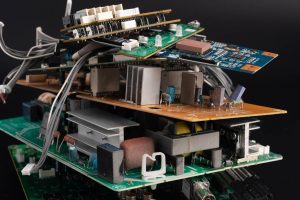
The very first PCB was created by an Austrian engineer named Paul Eisler for a radio set in 1936.
However, it wasn’t until after the Second World War was over that this technology was used for any commercial purpose. Until the late 40s, Eisler’s design was used exclusively by allied forces in the war. The biggest use came from the United States army who would use the PCBs to create proximity fuses. The circuit work helped the bombs go off on pre-calculated distances to take out planes, tanks, and ground troops.
Manual Labor & Giant Boards
In the 1950s, PCBs started to get mass-produced in factories across the United States and the United Kingdom. This was made possible by large-scale assembly factories that became commonplace at the time.
The factories would produce extra large circuit boards that could even be a few feet long. Individuals would have to walk across the circuit board and add all the circuit work to make a working PCB. At the time, small mistakes could ruin the PCBs completely, and it required a lot of care and cautious handling to make the PCBs. Everything from calculators to the Apollo 11 used PCBs.
Modern-Day PCBs and Usage
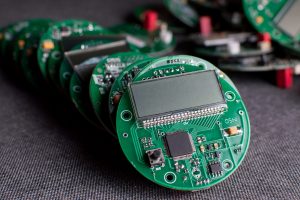
Modern-day PCBs are minute. They’re small enough to add multiple high-powered PCBs to small devices. Our smartphones themselves have 12 layers of more of PCBs stacked that make it work while still getting thinner every year. The development of PCBs has put us in what’s called the Hybrid years; one device gives you multiple functions.
PCB assembly and other electronics design services are required part of any OEMs looking to mass-produce their products. If you’re on the lookout for reliable embedded design services or electronics assembly services, check out our Find an EMS platform to connect with a registered EMS. Get in touch today.
How Do EMS Providers Decide Which OEMs to Partner With?
Original Equipment Manufacturers (OEMs) tend to struggle when searching for an EMS provider (aka contract electronics manufacturer) for their projects. Despite the plethora of options available, finding an EMS provider can be a long and tedious process. This is often due to the EMS provider’s (un)willingness to collaborate, rather than the OEM’s ability to look for a partner.
Wondering what considerations EMS providers keep in mind when choosing to collaborate with OEMs? Let’s take a look at some of these.
Market Match
One of the first things EMS providers check when approached by OEMs is whether or not the latter is a good market match for them. They’ll want to know what market sector you as an OEM are selling into, and if it’s a sector they have experience supplying to.
Think of it this way: just like you’d prefer to work with a business partner who has experience in your field, an EMS provider would also want to collaborate on projects where their industry experience and relevance can be matched. Thus, if your market sector doesn’t fall within the scope of an EMS provider’s target industries, you’re likely to hear back a “No” from their end.
This isn’t necessarily a bad thing. In fact, it’s recommended that OEMs partner with EMS providers who have relevant knowledge and experience working in the same industry. It just means that you’ll have to keep looking a little longer.
Production Volume
Another deciding factor for EMS providers is the volume required. Many EMS providers support prototype quantities and are willing to produce small volumes for the OEM in question. However, they may struggle to keep up with increased demands over time.
On the other hand, EMS companies cater to medium to high manufacturing volumes at a time, and cannot produce components in a lower volume. This is why many EMS companies prefer getting involved after the prototypes have already been a success in the market and there is a demand for more.
What to Consider before Hiring an Electronics Manufacturing Service Provider
Checkout our Infographic on what to consider before hiring an EMS partner.

Find the Right EMS Provider for Your Products with These 4 Tips
With hundreds of EMS providers operating in the United States, finding the right supplier for your company can be difficult. If your company has experience with outsourcing electronic manufacturing, you probably have a fair understanding of what can be expected, however, every EMS provider is different and their services differ as well.
Here are some tips that will help you find the right EMS provider for your business:
Capabilities
While it’s easy to find a service that provides printed circuit assemblies, it’s essential to research a service that’s suitable for your requirements. It’s advised to look for EMS providers that deliver a complete range of outsourcing services, even if your company doesn’t yet require them. This makes it easier to expand your outsourcing when the time is right.
The location of the EMS provider
While the location of your EMS provider seems irrelevant, it’s important to consider the implications of their location when they are further away. The further away the factory is located, the longer it takes to deliver end products; delivery issues can also become more complex due to the distance.
Due to COVID-19, supply chain bottlenecks have been created and have led to strained relationships with OEMs and a loss of business for OEMs too. The pandemic has made businesses realize the importance of having vendors nearby.

Supply chain management
The ideal EMS provider has a steady supply chain in place, coupled with the financial stability to provide the services you require. Without these two aspects, there’s a risk the outsourcing project could fail. When shortlisting EMS providers, this is an area to particularly focus on.
EMS provider’s product quality
Quality is non-negotiable when deciding on an EMS provider. While all EMS providers will boast great quality, it’s essential to do your own research on the quality of products supplied. Look into the quality metrics used by the provider. Historical trends are also vital in determining whether their claims are true. Historical trends also depict whether or not the business has improved their services in the form of increased sales/ partnerships.
Get in touch with reliable EMS providers via our platform. Post your product EMS requirements on Find an EMS and the EMS providers reach out to you. Our platform can also help you access the best electronics assembly services for your needs and Electronic Contract Manufacturing Services.