
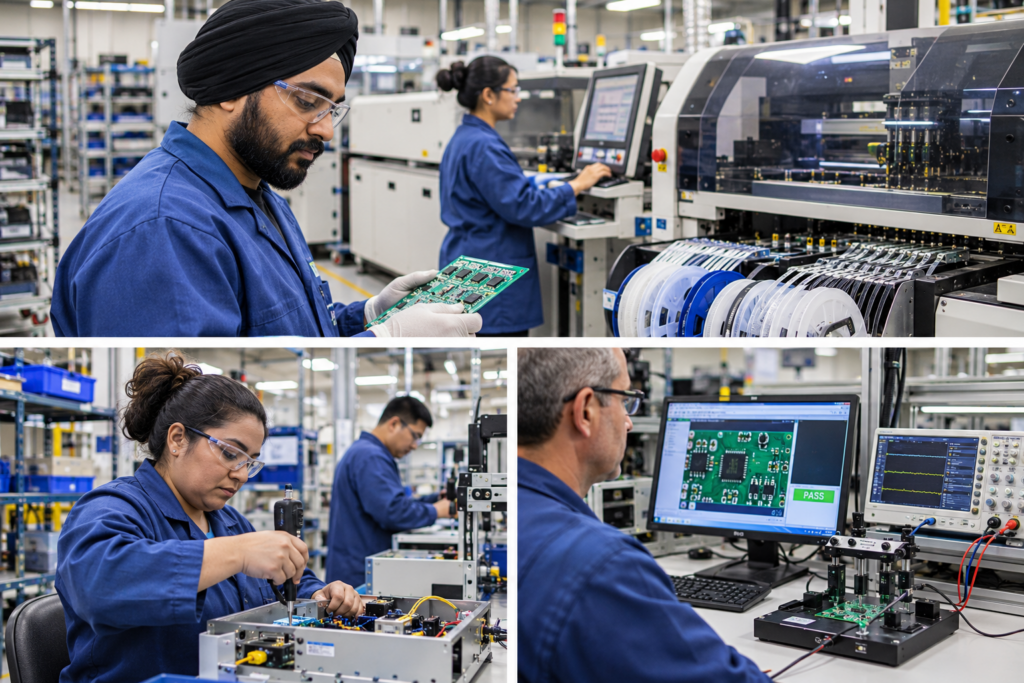
Choosing the right electronics manufacturing services (EMS) provider is one of the most important decisions an original equipment manufacturer (OEM) can make. A suitable manufacturing partner can help improve product quality, manage production costs, address supply chain challenges, and support a product as demand grows.
But not every EMS provider is the right fit for every project. Some manufacturers specialize in prototypes and low-volume production, while others focus on established products produced at scale. Some offer component sourcing, PCB assembly, testing, and final product integration; others specialize in a narrower set of services.
The best EMS provider is not necessarily the largest or least expensive. It is the one whose capabilities, production model, experience, and commercial requirements align with your product.
This guide explains how OEMs can evaluate potential electronics manufacturing partners and prepare for a successful manufacturing relationship.
1. Define your manufacturing requirements before searching
Before contacting potential EMS providers, establish what you need manufactured. Clear requirements help suppliers assess fit and make their responses easier to compare.
- Product type: What electronic device, assembly, or finished product needs to be manufactured?
- Services: Do you need PCB assembly (PCBA), cable assembly, electromechanical assembly, box-build integration, or complete product manufacturing?
- Development stage: Is the product in prototyping, new product introduction (NPI), pilot production, or ongoing production?
- Volumes: What are your initial order quantities, annual estimates, and expected demand variation?
- Testing: Will the product require functional testing, in-circuit testing, specialized inspection, or environmental testing?
- Quality requirements: Are particular standards, certifications, documentation, or traceability needed?
- Timeline: When are samples, pilot units, and production deliveries needed?
For example, an emerging hardware company preparing to manufacture 500 units of a new IoT device may need a different partner than an established OEM producing 50,000 automotive electronic assemblies. Defining requirements first makes both searches more productive.
2. Evaluate manufacturing capabilities
EMS providers differ in their equipment, services, and technical expertise. Determine which processes a provider can perform and which it coordinates through subcontractors.
| Capability | What it involves |
|---|---|
| PCB assembly (PCBA) | Mounting and soldering electronic components onto printed circuit boards. |
| Surface-mount technology (SMT) | Automated placement and soldering of surface-mounted components. |
| Through-hole assembly | Installing components with leads inserted through PCB holes. |
| Cable and wire harness assembly | Manufacturing cables, terminations, and grouped wiring assemblies. |
| Electromechanical assembly | Integrating electronic and mechanical components. |
| Box-build integration | Assembling boards, wiring, enclosures, and components into finished products. |
| Testing and inspection | Checking assembly quality and verifying defined product functions. |
| Component sourcing | Purchasing and managing parts needed for manufacturing. |
A company that offers PCB assembly may not offer complete box-build services or specialized testing. Ask what is performed internally, what is subcontracted, and who takes responsibility for quality and delivery. Subcontracting is not inherently a problem, but accountability should be clear.
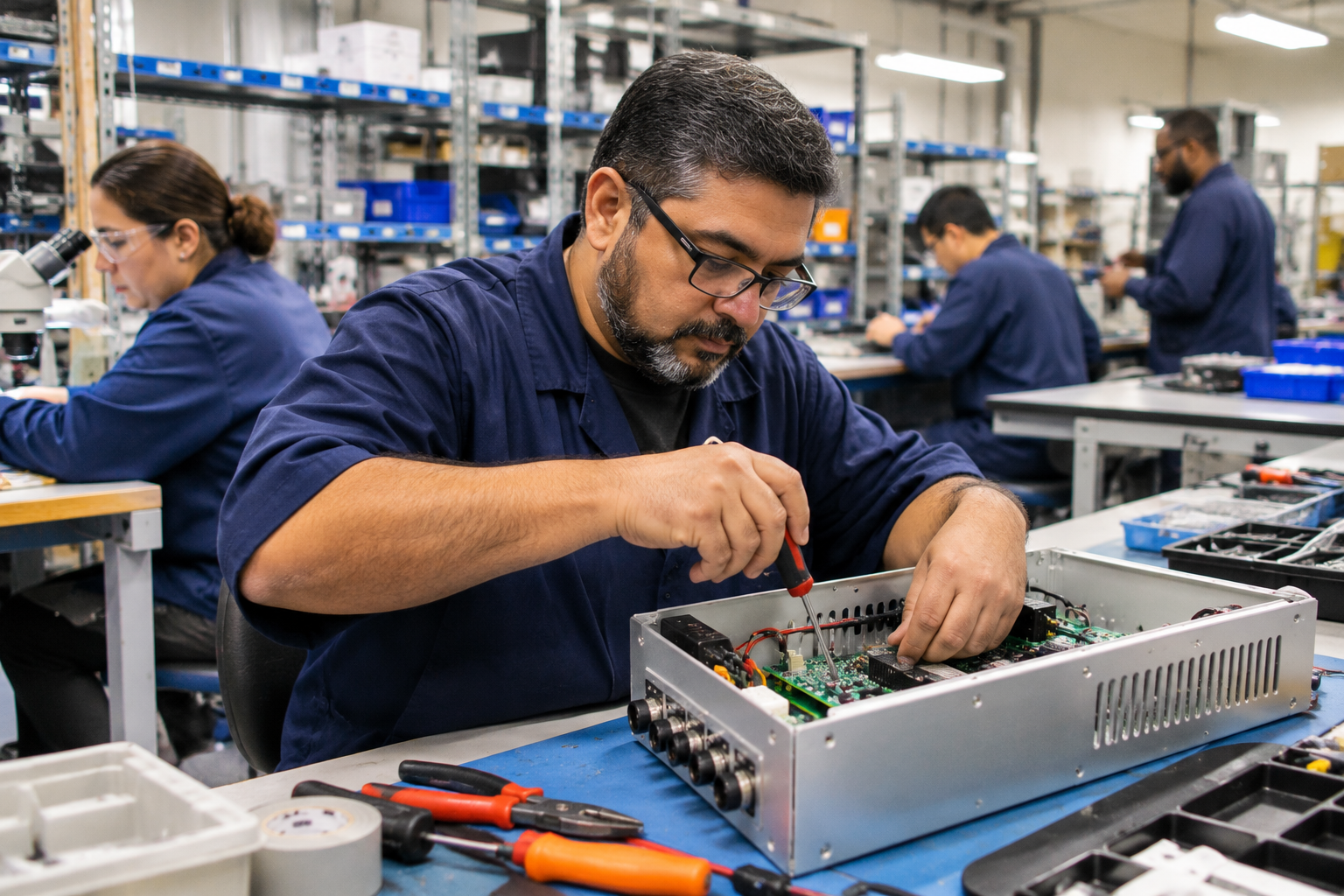
3. Match the manufacturer to your production volume
Production volume strongly influences which EMS provider is a good fit.
Prototypes and low-volume production
Smaller or flexible providers may be well suited to engineering changes, prototype iterations, and short production runs. This can be particularly helpful for startups validating a product before scaling.
Medium-volume production
As volume increases, materials planning, process consistency, automated assembly, inventory management, and repeatable quality controls become more important.
High-volume production
Manufacturers optimized for high-volume work may offer economies of scale for stable products, but their minimum order quantities, setup costs, and scheduling requirements may not suit early-stage products.
Ask about typical production volumes, minimum orders, support for prototype and pilot builds, engineering-change flexibility, and the ability to accommodate demand growth. A provider that can support your current stage and a credible next stage may be more useful than one optimized only for much larger orders.
4. Consider new product introduction (NPI) support
For new products, manufacturing preparation often starts before full production. New product introduction (NPI) involves preparing a design and process for reliable, repeatable manufacturing.
Design for Manufacturability (DFM) reviews whether a product can be built efficiently and consistently. Design for Testability (DFT) considers whether the design supports the inspections and tests needed to verify it.
A prototype PCB may function correctly but still present difficulties in automated assembly or testing. A provider with strong NPI support can help identify issues before larger production commitments.
Ask whether potential partners offer DFM feedback, test-development support, pilot builds, and a structured handoff to production.
5. Verify quality standards, testing, and traceability
Quality claims should be supported by evidence. Ask how a manufacturer controls processes, inspects output, measures performance, and addresses defects.
Relevant standards and certifications
Depending on the product and industry, relevant frameworks may include:
- ISO 9001: Quality management system requirements.
- ISO 13485: Quality management system requirements for medical devices, where applicable.
- AS9100: Aerospace quality management requirements, where applicable.
- IPC-A-610: Acceptability criteria for electronic assemblies.
- IPC J-STD-001: Requirements for soldered electrical and electronic assemblies.
- IPC/WHMA-A-620: Requirements and acceptance criteria for cable and wire harness assemblies.
Not every manufacturer needs every credential. Evaluate the requirements relevant to your industry, customer, and product. Also distinguish between an organization’s certification, individual worker training, and a contractual commitment to build to a specified workmanship standard.
For additional background, see ISO’s overview of ISO 9001 and IPC’s electronics manufacturing standards resources.
Testing and inspection
Depending on the product, capabilities may include automated optical inspection (AOI), X-ray inspection, in-circuit testing (ICT), functional circuit testing (FCT), environmental testing, and final inspection.
Ask which tests are performed internally and whether the provider can develop or execute a product-specific test plan.
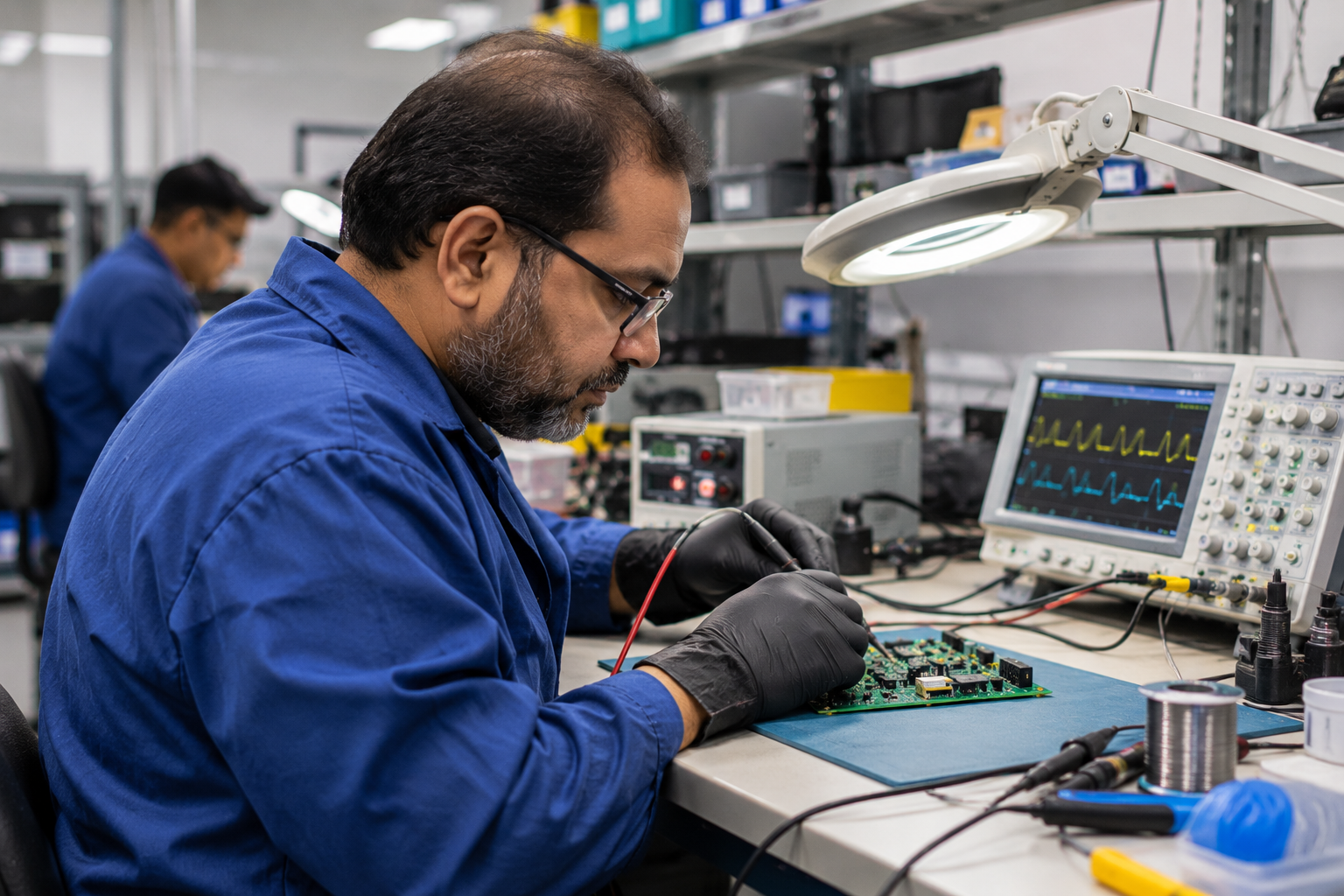
Quality measures to request
Useful measures can include first-pass yield, defect and rework rates, customer returns, and on-time delivery. Where possible, review historical performance and how the supplier handles nonconforming products and corrective actions. Determine whether material-lot, serial-number, production-history, and test-result traceability is available when required.
6. Evaluate manufacturing location and supply chain management
Factory location may affect logistics, delivery time, communication, import costs, and resilience. Domestic, nearshore, and offshore manufacturing can each be appropriate depending on your product and business needs. Location alone does not determine quality or total cost.
Evaluate how the EMS provider handles component sourcing and inventory. Useful questions include:
- Do you source components through authorized channels, and how are exceptions handled?
- How do you manage long-lead-time components and shortages?
- What happens when a component becomes obsolete?
- Who approves alternate parts or substitutions?
- Who owns excess and obsolete inventory?
- What visibility will we have into material availability and production schedules?
For component-constrained products, supplier purchasing practices and inventory management may be as important as assembly equipment.
7. Compare total manufacturing cost, not just unit price
Two quotations may show different per-unit prices because they include different services, assumptions, and contractual obligations. Compare proposals on a like-for-like basis.
| Cost element | What to compare |
|---|---|
| Unit manufacturing price | Materials, assembly labor, overhead, and volume assumptions. |
| Non-recurring engineering (NRE) | Setup, programming, engineering, and test development charges. |
| Tooling | Stencils, fixtures, specialized equipment, and ownership terms. |
| Component sourcing | Material pricing, substitute approvals, and inventory terms. |
| Testing | Inspection and functional testing included in the quotation. |
| Logistics | Packaging, freight, duties, and delivery responsibilities. |
| Quality response | Warranty terms, rework responsibilities, and corrective actions. |
Confirm that providers are quoting comparable quantities, bills of materials, test requirements, and delivery assumptions. The objective is to understand total manufacturing cost and risk—not simply select the lowest initial unit price.
8. Evaluate communication and long-term fit
Electronics manufacturing is an ongoing relationship. Even a technically capable EMS provider may not be suitable if communication is inconsistent or expectations are unclear.
Consider how each supplier manages project onboarding, engineering change orders (ECOs), production updates, component shortages, quality issues, and forecast changes. Ask who will manage your account and how engineering and manufacturing teams will collaborate.
For smaller OEMs, responsiveness and flexibility may be especially important when demand is uncertain or product designs are still evolving.
9. EMS provider evaluation checklist: 10 questions to ask
- Capabilities: Have you manufactured products with requirements similar to ours?
- Volume: Does our expected volume fit your normal production model?
- NPI: Can you support DFM reviews, prototypes, and pilot builds?
- Quality: Which relevant certifications do you hold, and which workmanship standards do you follow?
- Testing: What inspection and functional testing can you provide?
- Supply chain: How do you handle component shortages and obsolescence?
- Traceability: Can you provide the records our product requires?
- Cost: What tooling, testing, inventory, and engineering assumptions are in your quote?
- Capacity: Can you accommodate production increases and product changes?
- Communication: Who manages our project, engineering changes, and issue escalation?
This checklist is a starting point, not a substitute for a detailed supplier assessment, references, or factory audit when warranted.
10. Find manufacturers interested in your project
Once your requirements are clear, the next step is identifying EMS providers with the right capabilities and interest in your work.
With Find an EMS, OEMs can post electronics manufacturing requirements for participating EMS providers to review. Manufacturers interested in a project can express interest, enabling the OEM to identify potential partners and begin direct conversations.
Prepare a concise description of your product, required manufacturing services, current development stage, expected volume, preferred location, and timeline. Share confidential drawings, detailed BOMs, and sensitive design files only through an appropriate secure process.
For more on the process, see How Find an EMS Works. You can also explore articles in our Resources Library.
Frequently asked questions
What is an EMS provider?
An electronics manufacturing services (EMS) provider is a company that manufactures electronic assemblies or products for other businesses, typically OEMs. Services may include PCB assembly, sourcing, testing, cable assembly, electromechanical integration, and box-build production.
How do I choose the best EMS provider?
Define technical requirements, volume, quality expectations, and timing. Then compare suppliers on capabilities, production fit, testing, supply chain management, responsiveness, and total cost.
What is the difference between an EMS provider and an OEM?
An OEM develops, owns, or markets a product. An EMS provider performs electronics manufacturing services for an OEM or another customer. Exact responsibilities depend on their agreement.
Can EMS providers help with prototypes?
Yes. Some specialize in prototyping, NPI, and low-volume work, while others focus on larger-scale production. Ask prospective suppliers about their preferred order sizes and engineering support.
What should I provide when requesting an EMS quote?
Usually a product description, manufacturing specifications, bill of materials (BOM), design files where applicable, expected quantities, testing requirements, and timeline. Use suitable confidentiality and file-sharing arrangements for sensitive information.